Context & premise
Let’s assume that a unit — hotel, guesthouse, tourist complex or other building with significant energy consumption — has a photovoltaic system with a capacity of 200 kWp installed and wants to maximize the benefits: reduce the energy bill, increase self-consumption, protect against tariff fluctuations and have an efficient backup.
We’ll show why adding a 0.5 MWh (500 kWh) battery makes real sense — especially if your average daily consumption is ~400 kWh/day.
Estimated annual production for 200 kWp system
- To evaluate the annual energy production of a photovoltaic system, there are standard formulas. E.g. average solar radiation, surface area, panel efficiency and system losses are taken into account.
- Basically, in Europe a photovoltaic system produces (on average, depending on radiation and orientation) between ~1,000 – 1,400 kWh / kWp / year — this value depends on the geographical area, orientation, losses, etc. In some estimates, 1 kWp produces about 750–850 kWh/year, but under good conditions we can go towards higher figures.
- If we apply – with the caveat that these are estimates – let’s say conservatively: 1,200 kWh/kWp/year × 200 kWp → ≈ 240,000 kWh / year.
This is the gross energy generated by the panels, before self-consumption, losses, night-time consumption, etc.
Consumption & requirement: 400 kWh/day
- If the unit consumes ~400 kWh/day, that means ~146,000 kWh/year (400 × 365).
- Compared to the estimated production of 240,000 kWh/year: there was enough surplus for part to go towards self-consumption + storage + grid claim or to cover evening/night consumption.
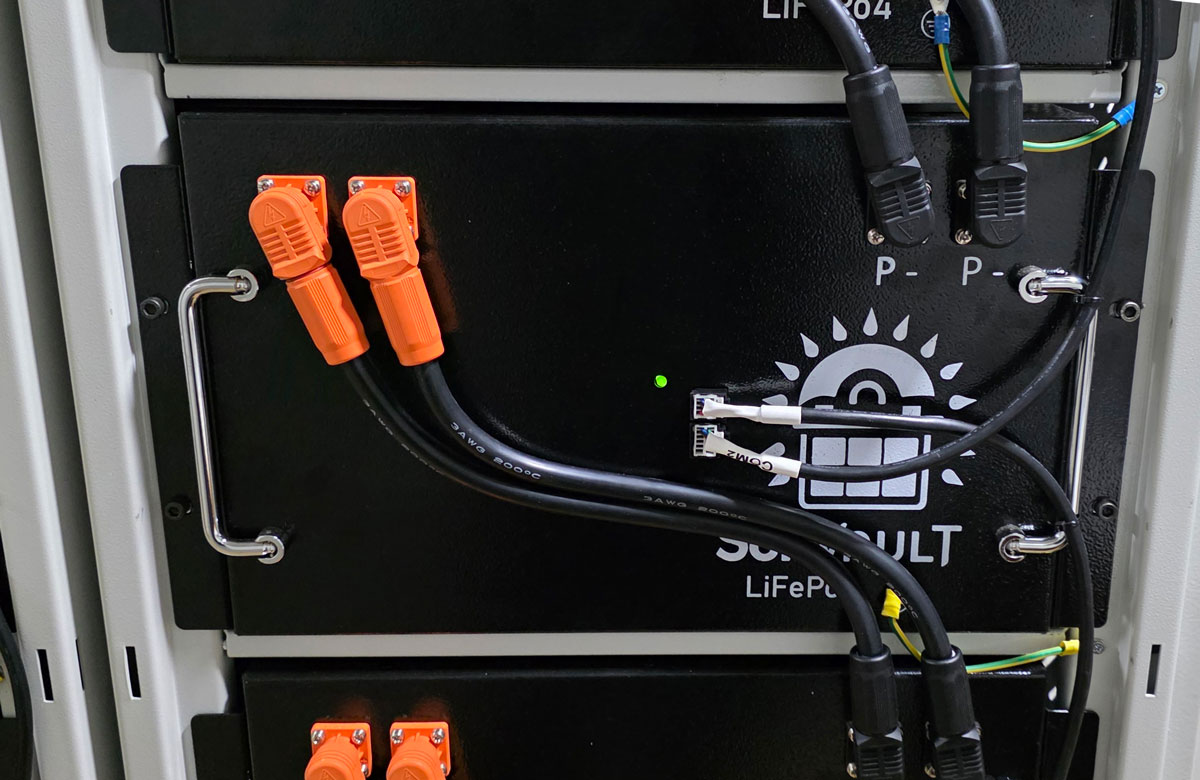
The role of the 0.5 MWh (500 kWh) battery
A 500 kWh battery brings several key advantages:
- If the system produces much more than is consumed on sunny days, the surplus can be stored — and used at night or during cloudy periods.
- Even with a daily consumption of 400 kWh, the battery could cover ~ 1–1.25 days of consumption if fully charged — useful for continuity (events, high-rate nights, grid backup).
- As a result, self-consumption from PV energy increases significantly and grid dependence decreases.
Thus, the combination “200 kWp + 0.5 MWh battery” becomes very attractive for units with consistent but variable consumption — hotels, guesthouses, buildings with 24/7 activity.
Potential savings — scenario with price of 1.5 lei/kWh imported
Assuming that without the battery, the remaining consumption not covered by PV would be imported from the grid at 1.5 lei/kWh:
- If the system + battery manage to cover 100% of the annual consumption of 146,000 kWh, this means avoiding payment of ~ 219,000 lei / year (146,000 × 1.5).
- Even if you cover only 70–80% of your consumption (through self-consumption + storage + PV), the savings can be significant — reduced energy imports + protection against tariff increases.
Moreover, for hotels & guesthouses, there is the added benefit of uninterrupted power supply (no risk of power outages) — an important aspect for customers, spa, lighting, security.
Why it matters now — context & opportunity
- Energy prices are becoming increasingly volatile; each kWh imported has a real cost and commercial risks.
- A PV system without a battery has limited utility: it produces energy “when it’s sunny”, but does not cover consumption at night or during periods of low sky.
- By adding a battery of the right size, you transform the system into a complete solution, capable of ensuring consumption, autonomy, continuity and significant cost reduction.
For hotels, guesthouses, buildings with non-stop activity or variable consumption — such a package is particularly valuable.
Conclusion + Call to action
If you already have — or are planning to install — a medium/large-sized photovoltaic system (e.g. ~200 kWp), it is worth considering adding a 0.5 MWh battery.
The advantages are concrete:
- increased self-consumption
- real savings on energy bills (possibly > 200,000 lei/year, depending on consumption)
- independence from the grid / tariffs / power outages
- business continuity — critical for hotels & guesthouses
Request a free evaluation of your existing system or a new system. A real analysis with concrete data allows us to accurately estimate savings, investment amortization, and optimization potential.


