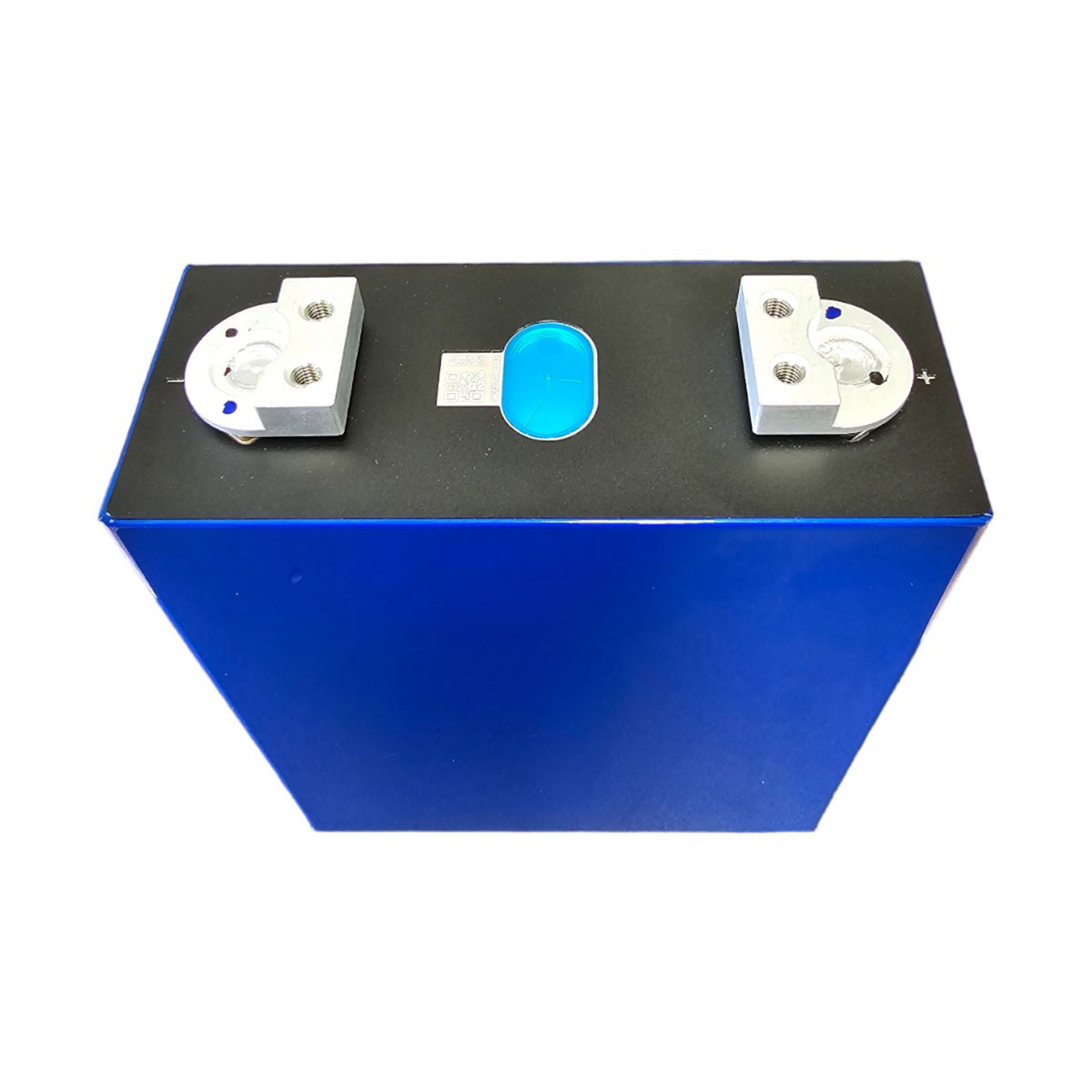
1. EVE LF304 (304 Ah, prismatic LFP cell)
Advantages:
- High capacity: 304 Ah nominal, ideal for applications requiring long autonomy.
- Solid lifespan:
- 4000 cycles at 25°C up to 80% SOH.
- 2000 cycles at 45°C, suitable for warmer conditions.
- High discharge current:
- Continuous discharge of 0.5C (152A) and 3C short-term (30s).
- Thermal stability: Operates over a wide temperature range (-35°C to 65°C for discharge).
- Low internal resistance: Approximately 0.16 mΩ (AC, 1kHz), leading to better energy efficiency.
- Low weight compared to capacity: 5.45 kg, offering good energy density.
Disadvantages:
- Compression required: Requires a specific compression force of 3000–7000 N to prevent swelling.
- Poorer performance at extreme low temperatures: Only 75% retention capacity at -20°C.
Ideal uses:
- Residential energy storage systems (e.g. solar batteries).
- Mobile applications (e.g. small electric vehicles).
- Off-grid applications with long cycle requirements.
2. EVE MB31 (314 Ah, prismatic LFP cell)
Advantages:
- Higher capacity and energy: 314 Ah and 1004.8 Wh nominal, ideal for applications requiring higher energy storage.
- Excellent lifespan:
- 8000 cycles at 25°C up to 70% SOH, double that of LF304.
- Extended operating temperature:
- Discharge possible between -30°C and 60°C.
- Better retention capacity at low temperatures.
- High energy efficiency: Over 95% at 0.5P and 1P discharge rates.
- Less compression requirements: Can tolerate higher forces without damage (10,000 N max).
Disadvantages:
- Higher weight: 5.6 kg ±300 g, which reduces the gravimetric energy density.
- Lower continuous current: Limited to 0.5P for charging and discharging (equivalent to 502.4W continuous), lower than LF304.
Ideal uses:
- Commercial energy storage applications with high cyclic requirements.
- Large electric vehicles or industrial storage.
- Systems with strict requirements for durability and efficiency.
Comparative Conclusion:
- LF304: More suitable for small-scale energy storage systems and applications with moderate current requirements.
- MB31: Ideal for industrial, commercial applications or systems that require long life and high storage capacity.


